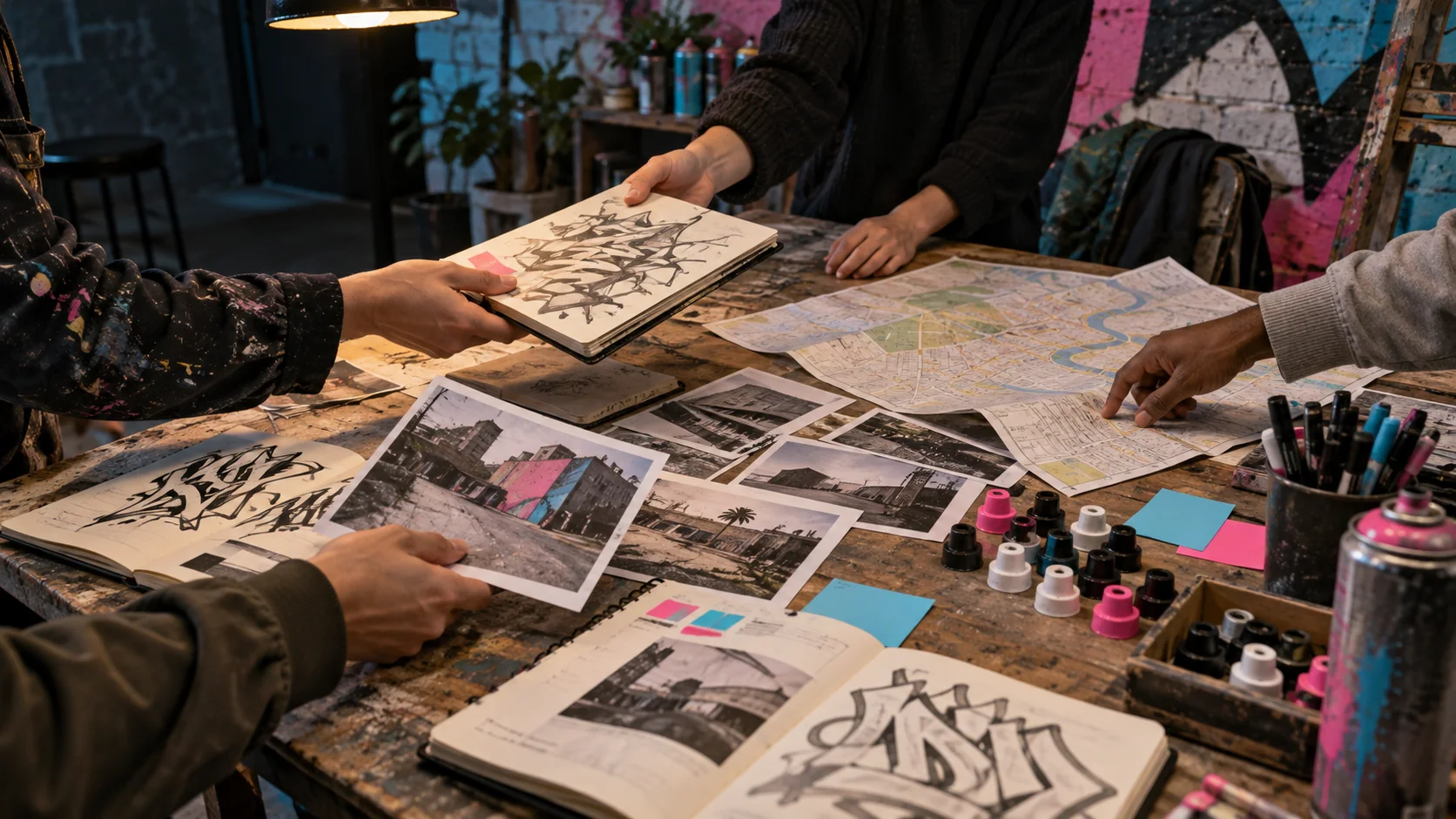
WallMinds is a field guide for people who want to understand graffiti as a craft, a public practice, and a living culture.
You can enter graffiti from many directions: through letters, walls, streets, or people. WallMinds connects those paths. Choose the question closest to what brought you here, then follow it from looking to making—and from making back to looking with sharper eyes.
Start with your question
Most visits to WallMinds begin with one of four questions:
- How do I make my letters stronger? Start with Wildstyle Lettering for skeletons, bars, spacing, connections, outlines, fills, and depth.
- Where can I paint with permission? Use Legal Walls to find leads, verify current rules, and prepare for a session without guessing.
- What am I looking at in the street? Explore Street Art Culture to read scale, surface, placement, repetition, architecture, and change over time.
- How do local scenes pass knowledge forward? Visit Community Spotlights for artists, photographers, organizers, wall caretakers, and shared practice.
These are not separate worlds. A clean outline depends on the letters beneath it. A good wall session depends on a sketch, working caps, enough paint, permission, and respect for the people already using the spot. Culture lives in those connections.
Learn the craft from structure outward
Graffiti lettering becomes easier to study when you separate construction from decoration. Begin with the skeleton: the few strokes that keep each letter recognizable before arrows, extensions, highlights, or 3D enter the page.
Build bars around that skeleton. Check their weight, then the spaces between them. Add an outline only when the word already sits together. A bright fill cannot rescue four letters pulling in four different directions.
You may spend twenty blackbook pages drawing the same four letters before they begin to sit together naturally. That is not wasted paper. Change one variable at a time—width, lean, spacing, connection, cap pressure—and compare the result with the previous page.
Our wildstyle guide follows that order: skeleton, bars, negative space, connections, overlaps, arrows, color roles, depth, wall transfer, and drills. Complexity is built in passes. It is not sprayed on top at the end.
Understand the wall before you pack paint
A wall in a directory is a lead, not a guarantee. A faded burner, fresh throw-up, unlocked gate, or pile of empty cans does not prove that the surface is legal today.
Before a session, identify who controls the exact wall, check whether painting is open or booked, and confirm hours, age rules, permitted panels, content restrictions, and cleanup expectations. Look again when you arrive. A temporary closure, event booking, fresh sign, or construction fence can change the answer.
The legal graffiti spots guide gives you a verification sequence and a practical kit check. Permission comes first; then come sketch, paint estimate, caps, gloves, water, bags, masking tape, and a plan for taking everything home.
Read the street before you explain it
A tag, throw-up, piece, paste-up, stencil, character, and commissioned mural can share one block without sharing the same purpose. Start with what is visible.
Notice the surface and its scale. Follow the outline. Look for buff marks, older layers, repeated names, roller height, cutbacks, drips, fading, and the way a piece uses a shutter, pillar, trackside wall, or blank façade. Ask what the photograph proves and what it leaves outside the frame.
Observation comes before interpretation. That rule does not make writing colder; it gives the real details room to carry the story.
Learn from people without inventing them
Graffiti knowledge travels through blackbooks, paint sessions, jams, flick exchanges, shop counters, local archives, and conversations that may never be formally recorded. Credit the person or public source when you can. Do not fill a gap with a confident biography, expose a private identity, or publish sensitive access details just to make a story feel complete.
Community Spotlights are for repeatable knowledge and grounded experience: how a wall is maintained, how a crew organizes a jam, how a photographer dates an archive, or how an artist revised the same letterform across years of work.
Your first six exercises
Use this route over several sessions:
1. Draw one short word as simple skeletons. Do not add style yet.
2. Build even bars around it, then redraw it with one deliberate change in width or lean.
3. Make three versions of the fill and outline while keeping the letter structure unchanged.
4. Photograph three public works and describe only what you can verify from the image and place.
5. Check one legal-wall listing from directory lead to current operator rules without assuming the listing is enough.
6. Return to your first word, mark the weak spacing, and draw it again on a fresh blackbook page.
Read, notice, make, compare, improve. That loop matters more than trying to discover an instant personal style.
How WallMinds works
Four rules shape the publication:
- Verify facts. Dates, access, legal status, materials, and wall conditions can change.
- Credit people. Attribute public work and knowledge without exposing private identities or sensitive details.
- Separate observation from interpretation. Say what is visible, what is sourced, and what is your reading.
- Respect permission and context. An existing piece is not permission, and a public wall is still part of a shared place.
Technique articles offer methods to test, not commandments. Local accounts may disagree because scenes, surfaces, paint, weather, and traditions differ. Useful guidance should be specific enough to try and honest about where it stops.
Start exploring
If you came with a marker and a page full of letters, begin with Wildstyle Lettering. If you are planning a real paint session, begin with Legal Walls. If a wall, mural, photograph, or local story made you curious, enter through Street Art Culture or Community Spotlights.
Pick one path. Make notes. Test something small. Then return through another path—the useful part of WallMinds is where letters, walls, streets, and people begin to explain one another.