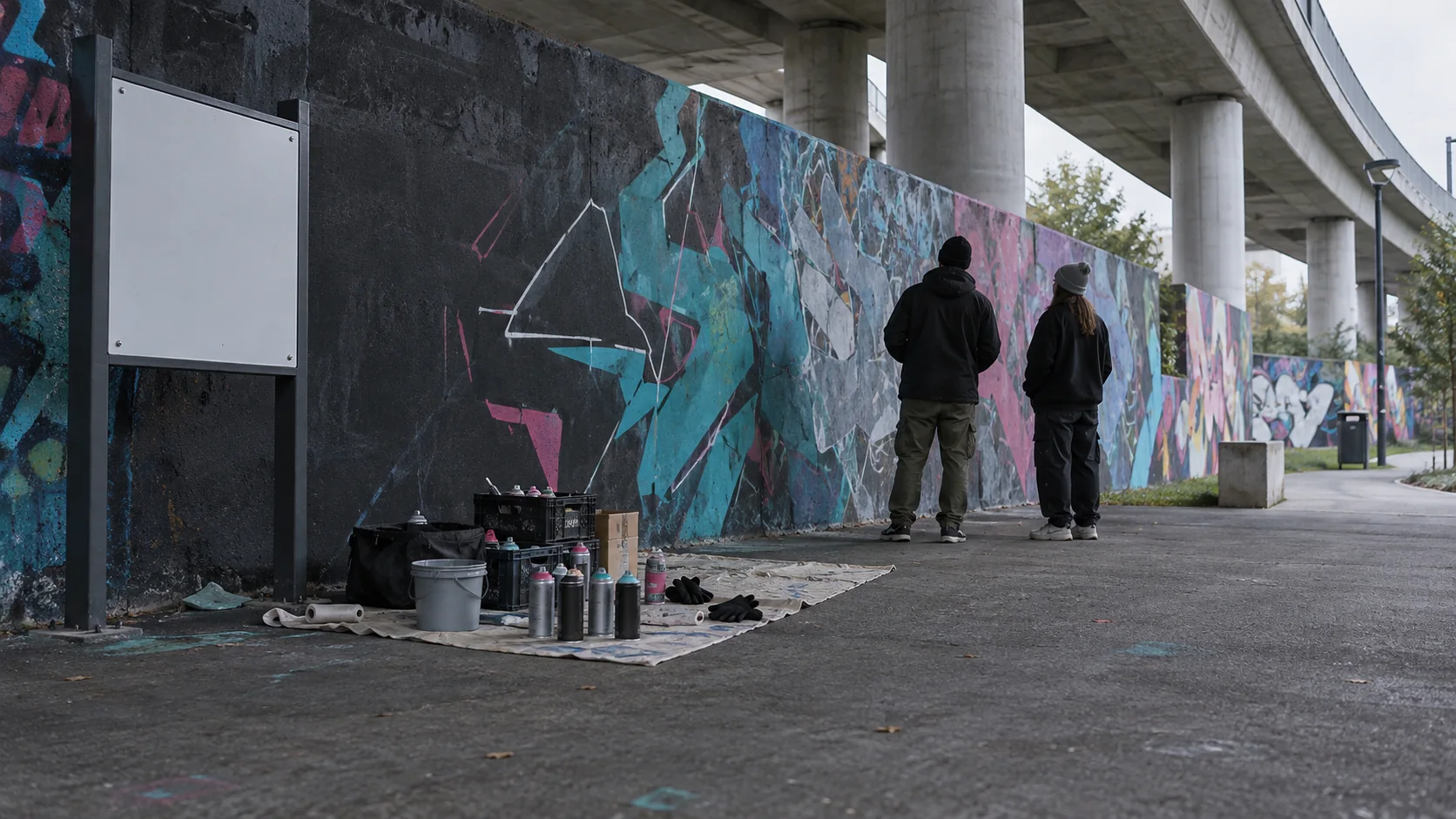
A map can help you discover a possible wall. It cannot, by itself, give you permission to paint. Listings become outdated, tolerated spaces are sometimes mislabeled as legal, and approval for one panel may not include the pillars, doors, paths, or neighboring structures around it.
This guide gives you a location-independent way to verify a spot before you travel with paint. It is practical general guidance, not jurisdiction-specific legal advice. Local law and the current rules of the owner or operator always take priority.
What “legal wall” can mean
Search results often group several different arrangements under one label. Before planning a session, identify which one you are dealing with.
- Open legal wall: a designated surface that can be painted without individual approval, subject to posted rules.
- Permission-required wall: a listed surface where the owner or operator must approve the artist, date, or design.
- Booked practice wall: a legal wall available only through a reservation or application.
- Tolerated spot: painting may be informally overlooked, but explicit authorization is absent. Tolerated does not mean legal.
- Hall of fame: an established painting location with strong local conventions; its formal legal status and its social rules are separate questions.
- Private commission: an owner hires or authorizes an artist for a defined project. Contracts, design approval, insurance, permits, maintenance, and removal may apply.
- Closed or disputed listing: a location formerly used for painting but reported as unavailable, restricted, demolished, or no longer authorized.
Do not compress these categories into a single green map pin. Each status requires a different verification step.
Step 1: use directories to create leads
Start with a current map or directory such as Legal-Walls.net, which organizes community-maintained listings by country and city. Treat each result as a candidate, then inspect the evidence behind it.
Useful signals include:
- the date the wall was listed,
- the most recent first-hand confirmation,
- whether users have reported a problem,
- a status such as legal, permission required, tolerated, or closed,
- photographs showing the exact surface,
- access notes and links to the operator.
A listing with a recent confirmation and a link to current municipal rules is stronger than an old pin with no notes. Neither replaces permission when the wall requires it.
Step 2: use an evidence ladder
Not every source carries the same weight. Work down this ladder and stop when the evidence becomes contradictory.
1. Current official rules from the owner or operator. A municipal page, venue page, booking system, or sign at the designated surface.
2. Current written approval. A message or document from the person or organization authorized to control that exact wall.
3. Current confirmation from a wall caretaker or event organizer. Useful when that person is clearly responsible for the space.
4. Recent first-hand community report. Valuable for detecting closures or changed access, but still worth confirming locally.
5. Undated or old directory entry. A discovery lead, not a green light.
6. Visual assumptions. Existing graffiti, an abandoned appearance, or an unlocked gate prove nothing about permission.
Screenshot the current rules or keep the confirmation message available offline. If police, security, an owner, or an organizer asks what you are doing, you should be able to explain the basis of your permission without relying on “someone online said it was fine.”
Step 3: identify who controls the surface
The nearest business is not necessarily the owner. An event organizer may control a wall only during an event. A tenant may not be authorized to approve permanent changes to an exterior. Infrastructure can belong to a transport agency, road authority, municipality, utility, or private landowner even when it looks unused.
Ask a precise question:
> Who has authority to approve painting on this exact surface?
For a private wall, get the owner or authorized manager to confirm the wall, participants, date, and scope. For public infrastructure, find the responsible authority or published program rather than assuming that city ownership means public permission.
Step 4: confirm the exact scope
Permission should answer more than “Can I paint there?” Confirm:
- the exact face or panel you may use,
- whether columns, doors, barriers, ground, and adjacent structures are excluded,
- the approved artist or group,
- the date and time window,
- whether booking or check-in is required,
- whether you must carry confirmation or photo ID,
- rules for people under 18,
- permitted materials,
- content restrictions,
- preparation and cleanup duties,
- how long the work may remain,
- who can remove or paint over it.
Official programs vary substantially. Warsaw’s FREE GRAFFITI zones use visible signs to identify designated spaces and publish content restrictions. Inner West Council’s HJ Mahoney Reserve conditions illustrate a stricter model involving bookings, named applicants, time-limited approval, identification, age requirements, cleanup, and temporary work. “Legal wall” does not imply one universal access policy.
What does not prove legality
Several common signals are useful for discovery but unsafe as proof:
- The wall is already covered. Previous work may be unauthorized or the rules may have changed.
- The property looks abandoned. Someone still owns or controls it, and entering it may create a separate access problem.
- Nobody stopped other painters. Lack of enforcement is not permission.
- A friend painted there last year. Ownership, construction, local policy, or operating hours may have changed.
- A map calls it tolerated. Tolerance describes uncertainty or practice, not explicit authorization.
- The owner did not reply. Silence is not consent.
- Permission exists for a nearby wall. Approval is normally limited to a particular surface.
When the evidence is weak, postpone the session and verify it. Paint and travel time are cheaper than cleanup costs, conflict, or losing a wall that the community worked to keep open.
Step 5: perform an arrival check
Even strong online evidence can be overtaken by conditions on site. Before unpacking, walk the boundary and check:
- current signs, notices, and wall numbers,
- temporary closure or construction,
- a booked session or organized event already in progress,
- fresh work occupying the surface,
- the border between the legal wall and adjacent property,
- pedestrian, cycling, road, rail, or emergency access,
- ventilation and wind around aerosol use,
- the surface condition and whether preparation is permitted,
- nearby residents, businesses, or facilities affected by noise and overspray.
If a sign contradicts the directory, follow the current sign and contact the operator. Report the change to the directory afterward so the next painter does not repeat the same mistake.
Legal rules, operator rules, and wall etiquette
These are related but not interchangeable.
- Law determines whether you are authorized to alter the property and may impose additional local restrictions.
- Operator rules define access, booking, content, materials, cleanup, and the boundaries of that particular program.
- Wall etiquette governs how painters share a changing surface: when to ask before covering work, how quickly pieces normally turn over, and how to avoid unnecessary conflict.
A session can satisfy one layer and fail another. You may have formal permission but still create conflict by covering a fresh, time-intensive piece without asking. Conversely, local acceptance does not replace authorization.
At an active hall of fame or practice wall, observe before painting. Look at how the surface turns over, speak to people present, and ask when the available area is unclear. Keep every mark, test spray, and background coat inside the designated boundary.
Prepare for the wall, not just the piece
Bring what the site rules and surface require. A basic responsible kit may include:
- the booking or permission record,
- identification if required,
- a sketch and color plan,
- paint and compatible caps,
- protective equipment appropriate to the product and ventilation,
- ground or edge protection when required,
- cleaning materials,
- bags or containers for used caps, empty cans, tape, and other waste,
- water, lighting, and weather protection appropriate to the session.
Do not apply primer, buff paint, coatings, tape, or fixings unless the rules allow them. Preparation changes the surface too and can extend beyond the permission you received.
Leave the space ready for the next person
Legal walls remain available because users and operators can live with the impact. At the end of the session:
1. collect cans, caps, tape, gloves, paper, and food waste,
2. remove protection without spreading wet paint,
3. check paths, fixtures, signs, vegetation, and neighboring surfaces for overspray,
4. restore access and move equipment out of shared routes,
5. photograph the finished work and the cleaned area,
6. credit collaborators accurately,
7. report a changed wall status or damaged sign to the operator or directory.
Assume the artwork is temporary. On many practice walls, being painted over is part of the format rather than damage to a permanent commission. Photograph the piece after cleanup, before weather or the next booking changes it.
A compact private-permission record
For a one-off private wall, a short written record is clearer than a vague conversation. It can state:
- owner or authorized contact,
- property address and exact wall,
- artist names,
- approved date and working hours,
- agreed subject or design constraints,
- allowed materials,
- surface preparation,
- protection and cleanup responsibilities,
- expected duration of the artwork,
- maintenance, repainting, or removal terms,
- contact method if questions arise during the session.
This is not a universal contract template. Larger commissions may require professional advice, permits, insurance, access equipment, or a more complete agreement.
Stop conditions
Do not start painting when:
- the listing is old and no current authority can confirm it,
- signs conflict with the online description,
- ownership or control of the surface is uncertain,
- the wall is only described as tolerated,
- the exact legal boundary cannot be identified,
- a closure, booking, event, or construction zone blocks access,
- permission covers someone else but not you,
- required confirmation, ID, supervision, or equipment is missing,
- safe access and ventilation cannot be maintained.
Pre-paint checklist
- [ ] I know the current status: legal, permission required, booked, tolerated, or closed.
- [ ] I checked the date and quality of the latest evidence.
- [ ] I identified the owner or operator responsible for the exact surface.
- [ ] I have any required booking or written permission.
- [ ] I know the approved wall boundaries, people, date, and time.
- [ ] I checked age, ID, content, material, access, and cleanup rules.
- [ ] Current signs and conditions match the information I found online.
- [ ] I understand the wall’s turnover and basic local etiquette.
- [ ] I can protect adjacent surfaces and remove all waste.
- [ ] I have a plan to document the work and report incorrect status information.
Directories and community knowledge are valuable because they make hidden opportunities visible. Use them as the first step, not the final permission. A good legal-wall practice is simple: verify the exact surface, follow the current rules, respect the people sharing the space, and leave it easier — not harder — for the next artist to paint.